

Caring for our Steel Magnolias
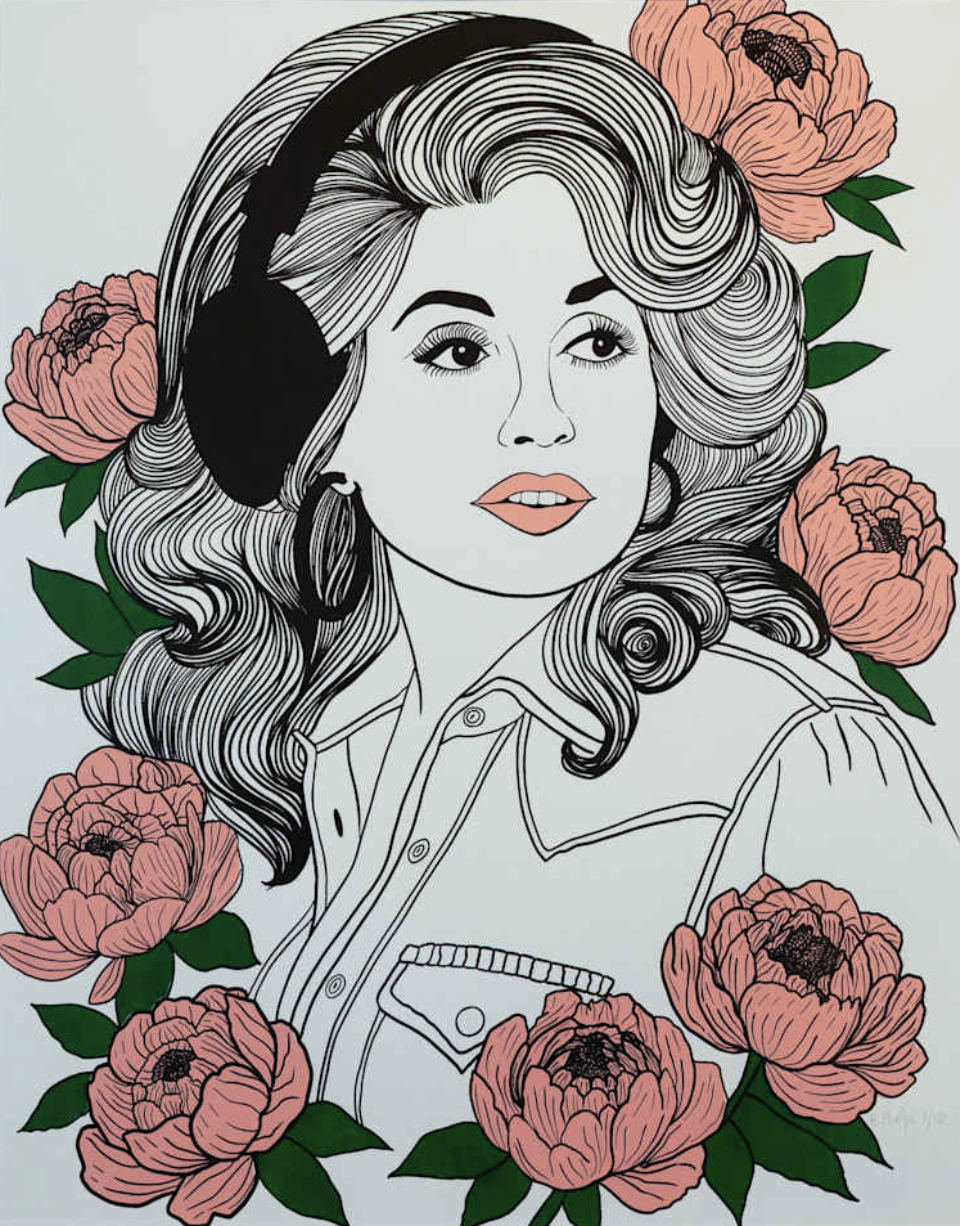
This beautiful print was created by DC-based artist Heidi Phelps, and I have purchased one for the entryway to my office.
The Great Unifier
Dolly Parton. Wow. Her death is a loss no words can describe. The ache and the pain. The person who brought us all together. The woman who encouraged us to get vaccinated in song. Whose books my children read, alongside children across our country's entire socioeconomic spectrum. The great unifier. I haven't been to Dollywood — I'm not big on theme parks — but friends who went say it's the closest thing they've ever seen to a microcosm of America, with mullets both literal and ironic.
Dolly was the quintessential country girl who owned that brand — and boy, did she own it, with her "country girl's version of glamour." I'm a city girl, but I've also lived in her world. I spent time in Appalachia working with a law firm on the public defender list, going into the jails to fight against the death penalty. I will never forget holding in my arms the baby of a 19-year-old our country wanted to kill; I saw that child, I saw the pain of the cycles of violence and the systems that perpetuate them, and I was forever changed. Dolly came from those same mountains and small towns, and she never pretended the pain wasn't there — she just refused to let it be the whole story.
Because Dolly was an artist in every sense of the word. A truth-teller to power. Someone who sparkled and chiseled her way through the glass ceiling with her superpower — like Ginger Rogers, doing everything the men did, but backwards and in high heels. And in Dolly's case, in rhinestones too.
My Steel Magnolia
I've seen the steel magnolias of this world, because my grandmother was one. The first person in her family to go to college, raised by her own grandmother without indoor plumbing in a small South Carolina town, she became a public school teacher — the first white teacher at an all-Black high school in Greensboro, NC, teaching social studies and living it, with my grandfather driving her through race riots and broken glass to get to work. He was a pastor, whose family literally sang for their supper and raised themselves out of poverty by becoming one of our country's iconic gospel singing families — a career he left for marriage and ministry, also being the first in his family to go to college. As the preacher's wife she was handed the teaching assignments no one else would accept — because as the pastor's wife, that's what you get. She was no-nonsense and she did the job, educating everyone she encountered, including me. Once, a powerful white man in her community who clearly wasn't keen to integrate asked her "where the Black people would sit" in church — as if the logistics were the issue. Without missing a beat: "Well, they can just come on down and sit in the pew with me." Which, as the pastor's wife, was always the second row, next to her five children — four boys and one girl, three redheads beside their platinum-blonde mother — who already stood out. Her retirement chapter took her to Indonesia, which became her favorite place on earth, where she received the respect she'd never gotten in America. She told me she only wished she'd gone sooner. My own career now has its own Southeast Asia story: friends in Indonesia are calling me back this October to support the work of lifting up our economy here in DC — a chapter we'll write together amidst the peace of a rainforest and in the heart of Singapore, an economy built on lifting up talent, no matter the package it comes in.
The Dance That Kept Us Going
Steel magnolias. It's not just a movie; it's a way of life. As someone who has lived in Dupont Circle in allyship with the gay community for two decades, I know what it is to be seen by people brave enough to wear sparkles and dance under disco balls while much of the world tells them that how they love — and who they are — is not OK. In this hard moment for our city, I often think of the mantra remembered from the AIDS crisis:
We buried our dead in the morning, advocated in the afternoon, and danced in the evening — and it was the dance that kept us going.
I'm a woman who has had global options, and Dupont Circle is where I choose to live and now raise my children. The debt of gratitude I owe the gay community for how they are shaping my little ones is one I hope to repay with my life and service. Dolly would have understood that completely. "Laughter through tears is my favorite emotion." DC is in a moment with a lot of tears, and I'm not ashamed — frankly, I'm proud — to cry them for my city and everyone in it, especially those who don't have the security I have. But Dolly, as always, gives us the answer. And the answer doesn't look like what you might imagine, which makes it only more powerful.
The Truth We Need to Hear
So I'll be bold enough to say the truth we need to hear as we wonder how to rebuild our city's economy — because truth is truth: women's creative entrepreneurship is a real economic strategy. Women are half of this country and half of this city. Women own 14.5 million American companies, employing almost 13 million people and generating $3.3 trillion in annual revenue. And here's the number every economic development professional should sit with:
Women-owned businesses hold nearly 40% of the ownership but capture just 6.2% of business revenue — and closing that gap to parity would add an estimated $10.2 trillion a year to the American economy. That's not a niche, but one of the largest untapped economic development opportunities in the country.
Dolly's Proof, in Numbers
Dolly herself is the proof, in numbers. Dollywood — the theme park she built in 1986 to bring jobs to her home county — is now the top attraction in Tennessee and has created more than 23,000 local jobs, according to a state government study. Her Imagination Library has provided more than 332 million books to children, a program she started because her own father couldn't read. I know what those missing books and missing options cost, because my own steel magnolia's father lived it: a man who loved reading and was often found at the local library, but with so few career paths open to him, he took the only jobs available and died of asbestosis. My grandfather picked cotton; my grandmother worked in a woolen mill as they made their way out of poverty — and their story became the rallying cry for my own career centering the workers in supply chains. Dolly's foundation's Buddy Program cut the dropout rate in her home county's schools from 35% to 6%. And when wildfires devastated Sevier County in 2016, she helped raise nearly $9 million, distributed directly to families as checks — with the remainder seeded into a fund still helping East Tennessee residents in 2024. One creative woman from a one-bedroom cabin: 23,000 jobs, 332 million books, a dropout rate cut by four-fifths, millions in direct cash to families in crisis. That's not a feel-good story. That's an economic development record most governments would envy — and it started with an artist claiming her stage.
Finding Our Dollys
And it's a strategy DC is already living, if we look. This week I toured the Anacostia Arts Center on its hardhat tour — 18,000 square feet for arts, entrepreneurship, innovation, and community care east of the river, opening in late February with a full month of festivals — built by and for a community that has been creating against the odds for generations. Last year I convened a Fresh Talk in partnership with the National Museum of Women in the Arts — the first museum in the world (!) dedicated solely to women artists. And it was an honor to convene a panel at NMWA with my friend and longtime collaborator Katrina Orsini of the George Washington University Textile Museum and the incredible Tracy Reese, who shared on stage why we have so many successful Black women in entrepreneurship: because all the other doors were closed. So that's how they built. And DC's Dollys have always been here — especially the Black women who built businesses, institutions, and whole neighborhoods east of the river while the city's attention and investment looked west. The talent was never missing, the stage was.
DC isn't known as a creative powerhouse — but that may be part of our power, just as Dolly was never seen as the economic leader she actually was. I spent much of my career building in the creative field with women-owned factories, centering the women in supply chains at home and around the world, and I've seen firsthand what honoring women's economic agency does for an economy.
DC, we need to find our Dollys — and build them a stage.
The good news: it's already happening. We just need to see it for the powerhouse it is. We have NMWA. The Anacostia Arts Center opens in February. And this very week — as the world mourns Dolly — the first FEMME Art Fair is running in downtown DC, centering women artists from across the country, with 100% of sales going to the artists themselves and the Guerrilla Girls on the walls. Their tagline says everything: Not a movement. A market correction. Women artists are 70% of the talent and receive 3.3% of the money — a pattern I saw firsthand in my own career in sustainable fashion, an industry where women are the workers and the consumers, yet men and extractive practices sit at the top. That's not a culture problem. That's an economic development opportunity hiding in plain sight.
Claim the Sparkle
If we're going to claim our power, we have to claim the sparkle too. The people who don't fit into boxes — including, and especially, us entrepreneurial, creative women. This power runs through our childcare, our public education system, and our businesses. It's grassroots power, and it's far stronger than anything handed down from above: it's not about ribbon cuttings, but the ribbons I now tie in my own daughter's hair as she starts back to school this week.
